Philosophy
of the Home
Reanimating Bhutanese Heritage
Artistic research collaboration with the Department of Culture and Dzongkha Development, Bhutan.
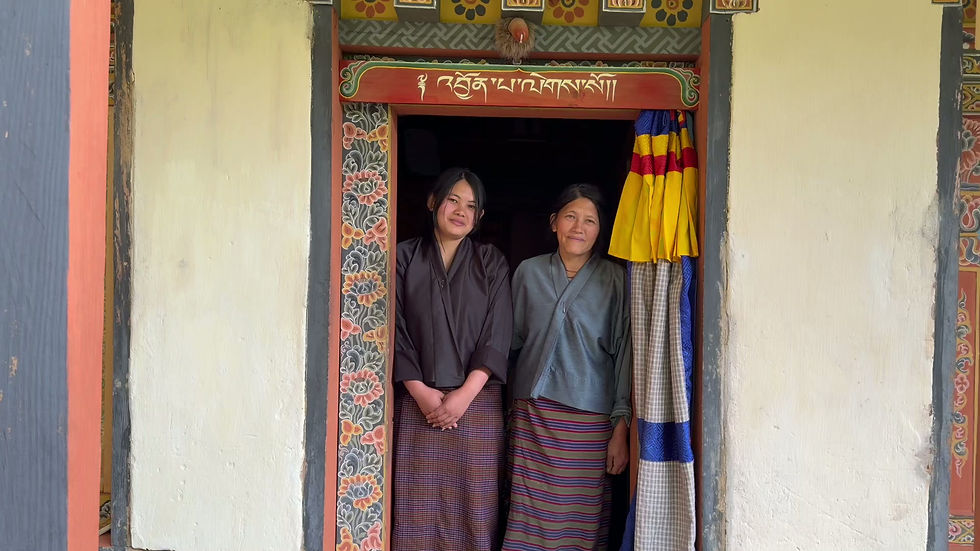
Philosophy of the Home is an ongoing artistic research collaboration between multidisciplinary artist Laura Dzelzytė and the Department of Culture and Dzongkha Development, Bhutan. Through anthropological fieldwork and sculptural practice, the project explores the home as a living repository of knowledge and women's role in sustaining cultural memory across generations. Working closely with Bhutanese communities, Laura documents domestic life and reanimates everyday objects and architectural fragments in translucent wax, transforming familiar forms into vessels of memory, care and continuity.
In many parts of Bhutan, land, property and household authority traditionally pass through the female line from mother to eldest daughter. Scholars of the Himalayan region, including Mona Schrempf, have observed that domestic and ritual authority in Bhutan has historically occupied a fundamentally different position from that found in much of the Western world. Here, the home is not simply a private sphere but a place where identity, ritual, inheritance and cultural continuity are actively maintained. The Bhutanese house emerges as a living archive through which women preserve and transmit knowledge, values and ways of being.
This understanding forms the conceptual foundation of the project. Drawing on the philosophy of Emilio Coccia, who describes the home as the epitome of moral reality, the work considers domestic space as a site where knowledge is embodied rather than codified. It offers an alternative to traditions that have historically privileged institutional, rational and economically productive forms of knowledge over those sustained through care, lived experience and intergenerational practice.
Developed through extended stays with Bhutanese families, visits to nunneries and participation in domestic rituals and religious ceremonies, the research informs an expanding body of work including essays, public events, documentary filmmaking and large-scale sculptural installations.
Central to the project is a series of wax sculptures in which Laura reimagines traditional household objects and architectural elements, culminating in the reconstruction of a Bhutanese heritage house from Nobgang. Preserving their form while transforming their material, these works invite viewers to encounter heritage not as something fixed or nostalgic, but as something living, vulnerable and continually remade.
Throughout Laura's practice, wax functions as both material and metaphor. More fragile than the objects it replaces, it preserves their physical presence while revealing the precarity of the histories they embody. In Philosophy of the Home, material transformation becomes a way of asking how cultures remember, how knowledge survives, and how heritage might be reanimated for the present rather than simply preserved for the past.
The project forms part of a long-term collaboration exploring Bhutanese cultural heritage through contemporary art, contributing to international exhibitions, publications and cross-cultural dialogue while laying the foundations for new ways of understanding home as both a physical place and a living knowledge system.

Laura Dzelzytė surveys a restored Kabu-Dharcham (house) in Nobgang, Bhutan